AI agents that investigate your security. And never touch it.
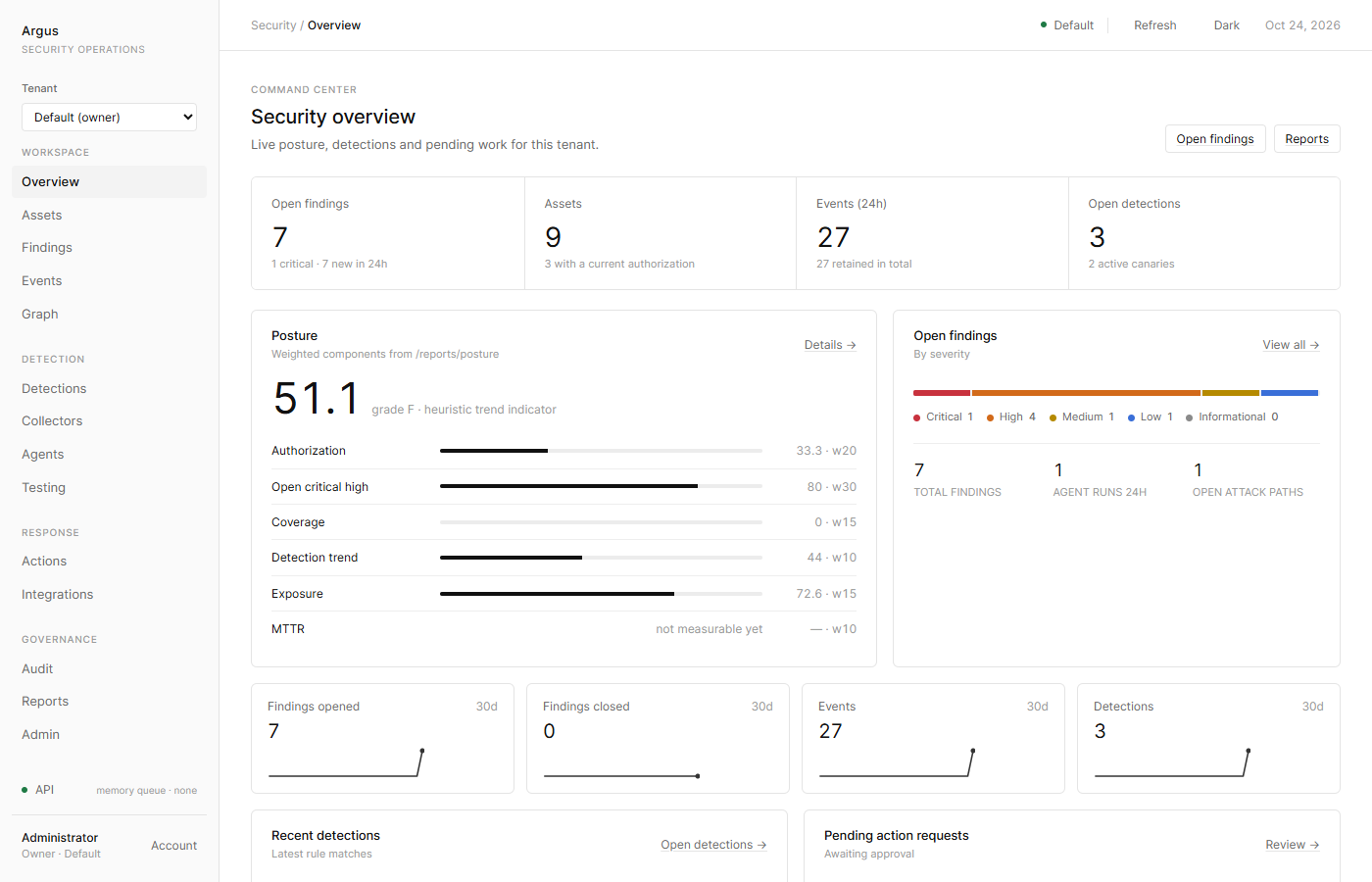
Argus is an open-source security operations platform. It maps your cloud, identity, code, endpoint, network and Kubernetes assets into one evidence graph, runs detections over what happens there, and puts governed AI agents to work on triage and investigation. The agents can read anything. They can change nothing. Every change goes through a separate action broker with policy, approvals, dry runs, rollback and a kill switch.
An AI agent is very good at working through a thousand alerts, a sprawling cloud estate and a week of identity logs. It is also the last thing you want holding admin credentials. One prompt injection hidden in a log line, and the agent that was meant to help you is now acting for someone else.
Argus separates thinking from doing. Agents get read-only tools over the evidence. Their one write-capable tool files a pending request. A separate broker, with its own policy and its own approvals, is the only component allowed to change anything. It shows you the blast radius first, keeps a rollback for everything it does, and stops on a single switch.
The agents analyze. People approve. The broker acts, and the audit chain remembers.
How it works.
Map the estate into one evidence graph
Collectors inventory your cloud accounts, identity providers, repositories, endpoints, network flows and clusters. Argus links them into a graph of assets, relationships and attack paths, and scores exposure. Thirteen inbound parsers take events from the tools you already run.
Catch what matters, including machine-speed attacks
A detection engine checks events against rules for swarm behavior, identity abuse, cloud exposure, Kubernetes, code and canary tokens, plus baselines and anomalies. Authorized security tools like Trivy, Nuclei, ZAP, Prowler and Semgrep run inside a recorded scope that is checked again at run time.
Governed agents do the legwork
Seven AI specialists triage, investigate and hunt with read-only tools. Everything they read is marked as untrusted data, every step is stored with its tokens and timing, and budgets cap steps, tokens, time and cost. Use Anthropic, OpenAI, a local Ollama model, or no model at all.
Changes go through the broker, never around it
An agent or an operator proposes an action. Policy checks it, a different person approves it (two for high risk), a dry run shows the blast radius, and it executes with a stored rollback. The tenant or global kill switch rejects everything instantly.
What your team sees.
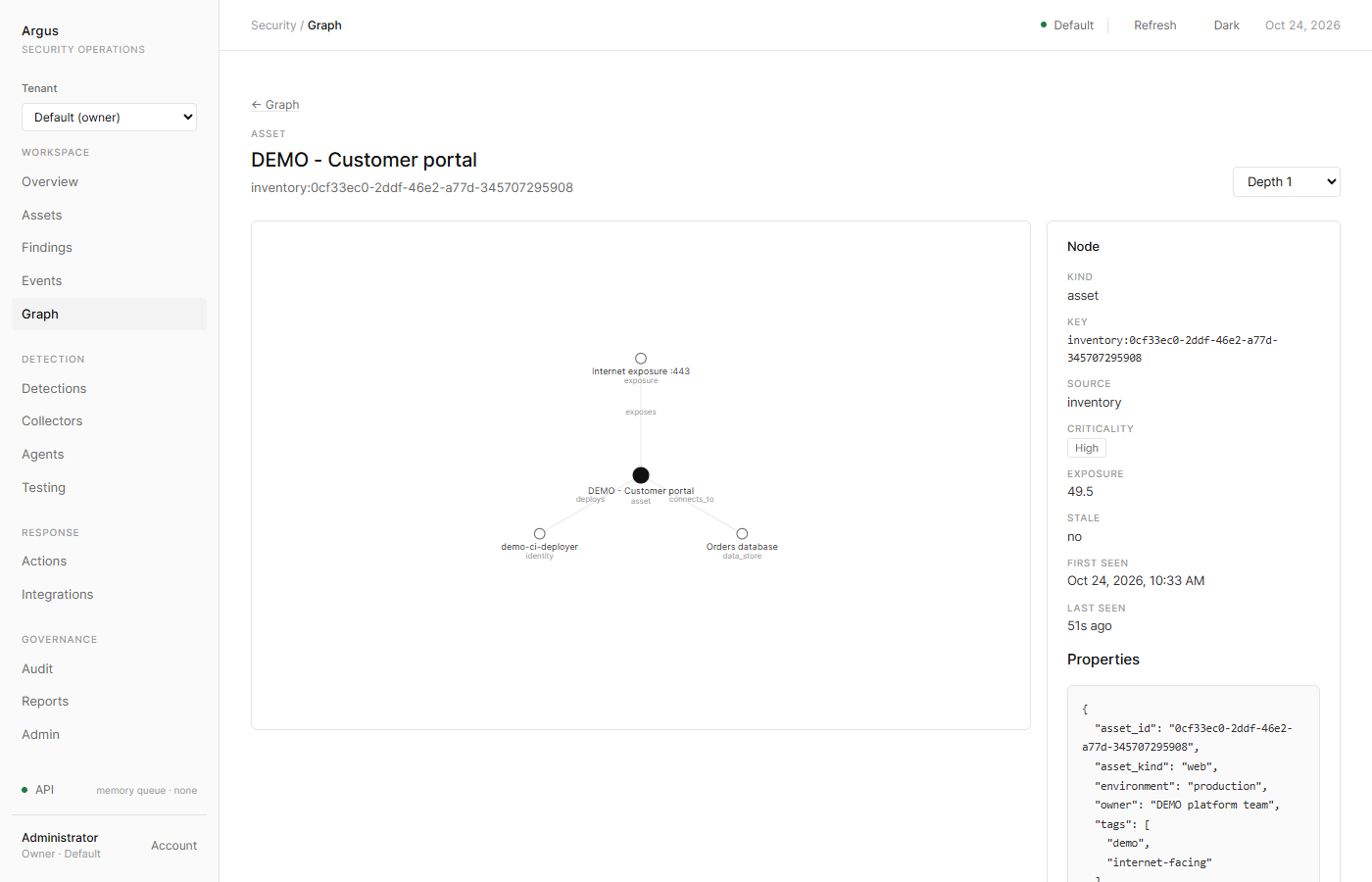
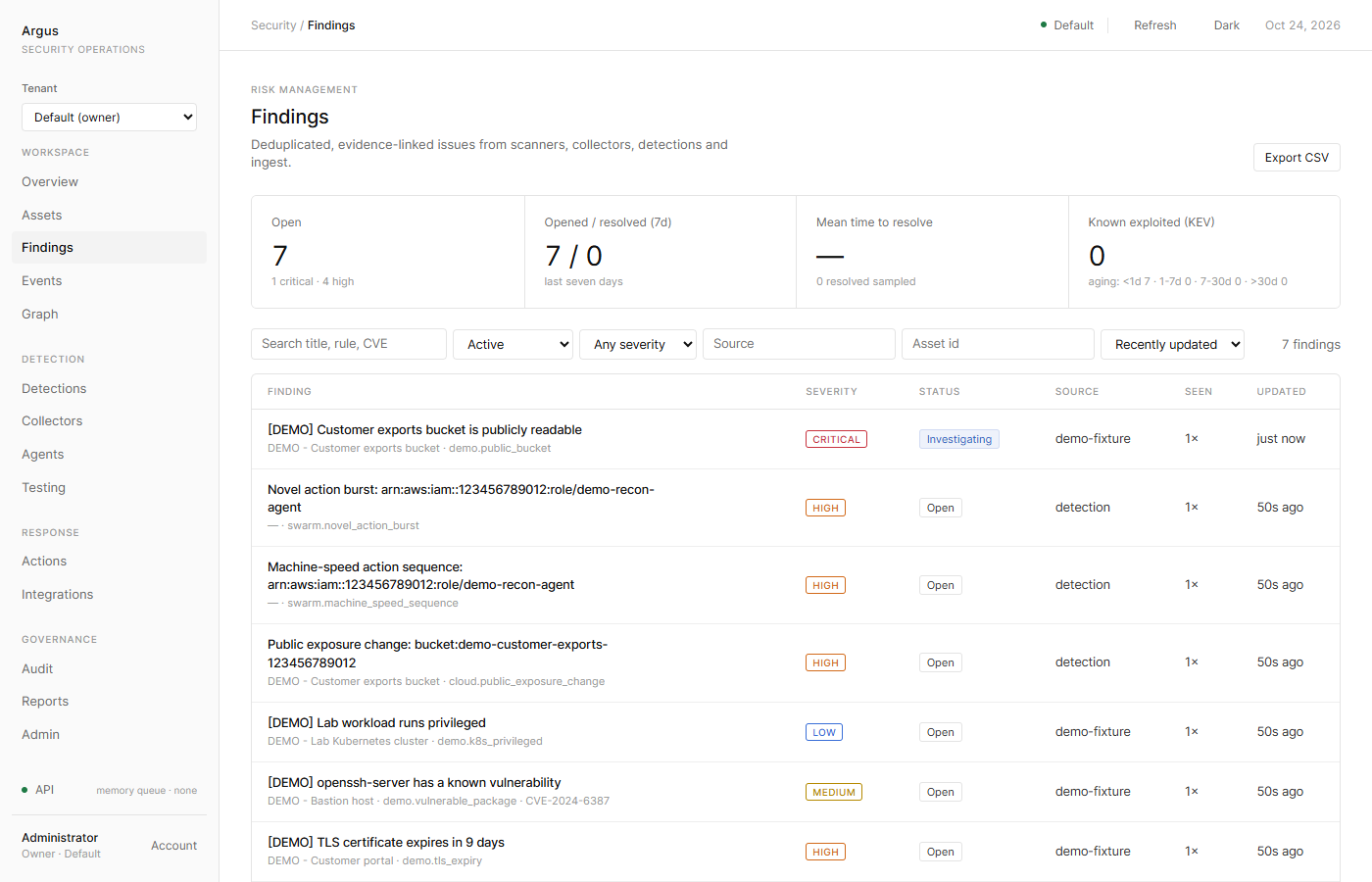
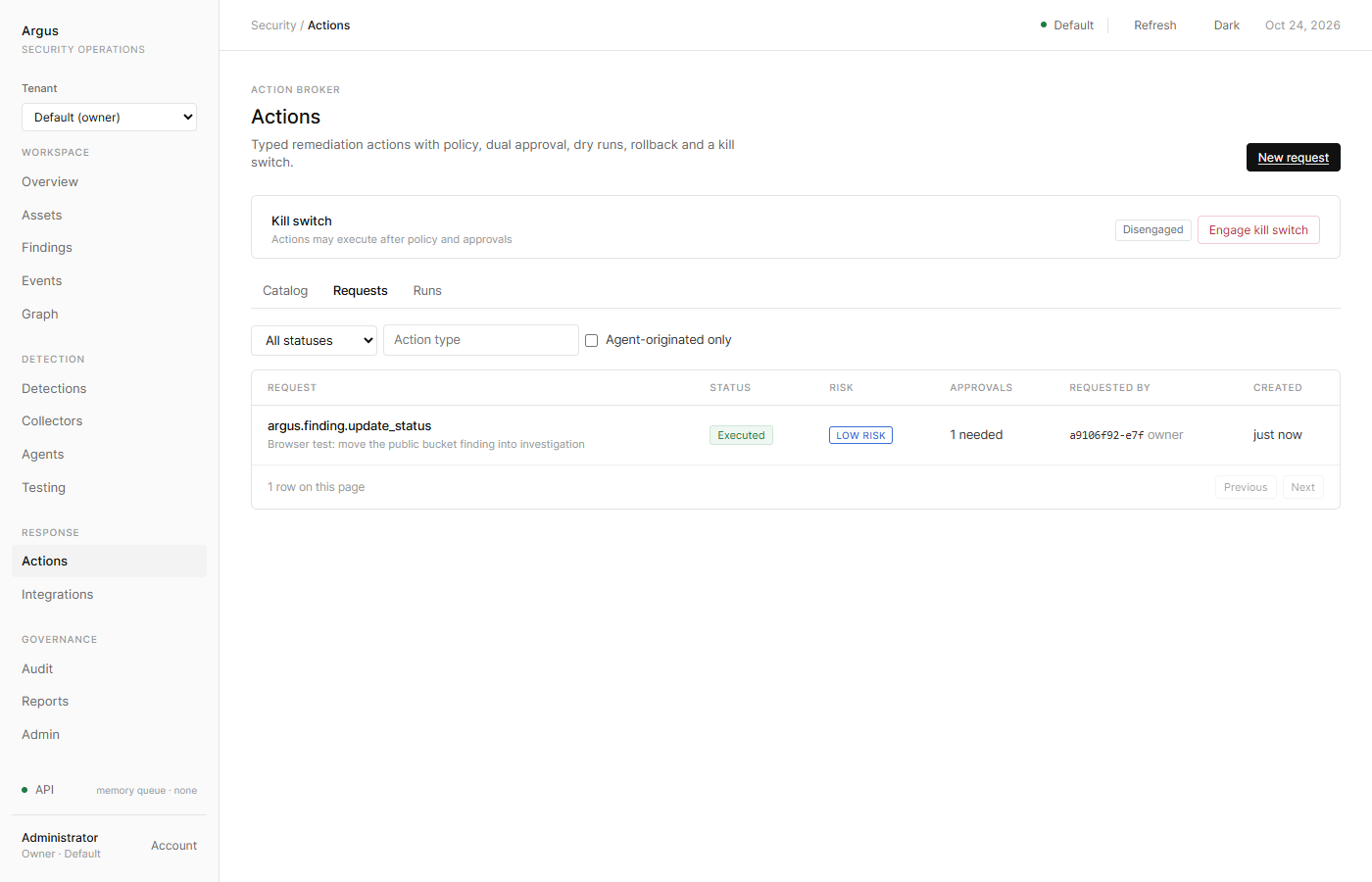
Built like the people who will audit it are watching.
Running on your laptop in five commands.
$ git clone https://github.com/thomasunise/argus.git && cd argus
$ python -m venv .venv && . .venv/bin/activate
$ pip install -r requirements.txt
$ cp .env.example .env && python scripts/generate_secrets.py --write
$ uvicorn app.main:app --host 127.0.0.1 --port 8080
Open 127.0.0.1:8080 and sign in with the admin login from .env. Run python scripts/seed_demo.py for synthetic demo data.
$ cp .env.example .env && python scripts/generate_secrets.py --write
$ docker compose up --build -d   # hardened containers, API on localhost only
For production there is a Helm chart for Kubernetes and Terraform for AWS (ECS Fargate, RDS, S3 Object Lock, WAF) and Azure (Container Apps, Key Vault, Front Door). Argus refuses to start in production mode without PostgreSQL, Redis, HTTPS, encryption and signing keys, an external audit sink, and SSO or two-factor. The full checklist is in docs/DEPLOYMENT.md.
Run it yourself, or have me run the install.
Free, forever
Clone the repo, follow the deployment guide, and adapt the collectors and rules to your environment. Best for teams with security engineers who want to own every line.
- MIT license, no seats, no usage fees
- Architecture, threat model, runbooks and go-live guide in the repo
- Issues and contributions on GitHub
I install it in your environment
For business owners and lean IT teams who want the protection without becoming the project. I deploy Argus in your own cloud, connect it to the systems you actually use, and hand it over running.
- Deployed in your AWS, Azure or Kubernetes account. You own all of it
- Collectors connected to your cloud, identity and code, and alerts routed to Slack, email or your ticketing
- Detection rules tuned to your environment and run in monitoring-only mode first
- Your team trained on findings, approvals and the kill switch
Argus questions, answered.
What is Argus?
Argus is a free, open-source security operations platform you host yourself. It inventories your cloud, identity, code, endpoint, network and Kubernetes assets into an evidence graph, runs detections on the events around them, lets AI agents triage and investigate with read-only access, and routes every change through an approval-gated action broker with dry runs, rollback and a kill switch.
Can the AI agents change anything in my environment?
No. The agents have read-only tools over Argus data. Their only write-capable tool creates a pending action request. That request then goes through the broker's policy, a human approval from someone other than the requester (two approvals for high-risk actions), and a dry run before anything executes. Anything the agents read is wrapped as untrusted data, so an instruction planted in a log line is treated as evidence of an attack, not a command.
Is Argus ready for production?
Argus is an early open-source foundation. The platform core (tenancy, authentication, roles, the audit chain, the queue, policy and approvals) is tested end to end on SQLite and PostgreSQL. The cloud and identity collectors and the action executors are tested against recorded fixtures and mocked APIs, and the twelve detection rules are an untuned starting set. Plan to adapt collectors and rules to your estate and run in monitoring-only mode before enabling any action. That tuning is a large part of what an assisted install covers.
Does it replace my SIEM or EDR?
Not necessarily. Argus takes events in from the tools you already run through thirteen inbound parsers, including a pull from a Wazuh indexer, and sends findings out to Slack, Jira, ServiceNow, PagerDuty, email and webhooks. Many teams will run it alongside existing tools as the layer that connects evidence, investigates it and governs the response.
Which AI models does it work with?
Anthropic Claude, OpenAI, local models through Ollama, or none. With no model configured, the specialists fall back to deterministic logic, so detection and triage still work. Budgets cap each agent run by steps, tokens, time and cost.
Does my data leave my network?
Argus is self-hosted, so the platform and its data stay in your infrastructure. The only outside calls are the ones you configure: the cloud and identity APIs it collects from, the channels you send alerts to, and a model provider if you choose a hosted one. With a local Ollama model or no model, the AI work stays on your machines too.
Does Argus make us SOC 2 or ISO 27001 compliant?
No software does that alone, and Argus is not a certified product. It ships a control mapping for SOC 2, NIST 800-171 and ISO 27001 that shows which controls it can provide evidence for, such as the signed audit chain, role-based access and approval records. Your auditor still assesses your program as a whole.
What does it cost?
The software is free under the MIT license. You pay for the infrastructure you run it on and for any model provider you use. If you want help, an assisted install is scoped and priced after a short call about your environment, and you keep everything, including the code, the configuration and the credentials.
I'm a business owner, not a security engineer. Is this for me?
The software is built for security teams, but the protection is for any business with cloud accounts, staff logins and code worth guarding. If you don't have someone to deploy and tune it, that's what the install service is for. Book a call, tell me what you run, and I'll tell you plainly whether Argus is the right fit or whether something simpler would serve you better.
Want Argus running in your business?
Thirty minutes. We look at what you run today, where the risk is, and what an install would take. You leave with a plan, a timeline and a fixed price, or a clear answer that you don't need it yet.